Blue Lagoon was a controversial film, released in 1980, that starred a then 14 year old Brooke Shields as a shipwrecked castaway, who is forced to grow up and mature on a remote island with her cousin (Christopher Atkins). The film however wasn't as controversial as Shields' previous role as a child prostitute in 1978's Pretty Baby, made when she was just 11 years old.
The film starts as the children are left on the island as pre-pubescent castaways, and follows them as they mature from the age of innocence, to an age of sexual awareness. They are initially guided to life on the island by fellow castaway Leo McKern, who soon after dies, after drowning whilst drunk. It is at this point that the children's loss of innocence begins, as they begin to deal with the darker side of life. Mirroring the children's evolution are images of natures on cycle of life, which they cohabit with on the island. However, these scenes come off as rather amateurish, simplistic and a bit too pretentious to really aid the film. The acting does manage to get away with any accusations of woodenness, due to the subject matter at hand, and both Atkins and Shields' manage to do an adequate job at portraying their naivety. McKern in fact manages to pull out a wonderful cameo at the start of the film, that matches his usual onscreen energy and persona.
Apart from the occasional flashes of child nudity, there is nothing really explicit that suggests this film should have garnered the controversy it did. In fact it comes across as quite pure, but ultimately a bit too sweet for it to be considered an accomplished work. Unfortunately, it does struggle to compete with the similarly themed Death in Venice and Lolita, which are far superior in style and execution. It's biggest strength comes from the source material from which it is based: Henry De Vere Stacpoole's novel of the same name; which leads me to think that this is a film that may do better being remade.
No Way Out was an espionage thriller starring a youthful Kevin Costner, as a naval officer who gets involved with the defence secretary's (Gene Hackman) mistress (Sean Young). The defence secretary kills his mistress by accident, and Costner's character is the man brought in to divert suspicion away from the defence secretary.
For such a convoluted plot, it is actually pulled off far more impressively than the synopsis suggests; although it may seem a little bit dated these days. There are moments of genuine tension and the film has one of the truly most bizarre endings in film history. The performances are also quite good, especially from Costner, who manages to carry the film well, though he is sometimes let down by Young's at times erratic demeanour. His scenes opposite Hackman invoke some of Costner's best scenes, and Hackman manages his usual level of vigour. David Bowie's wife Iman and Will Patton also provide impressive support.
For a film of it's ilk, that is probably quite forgotten in this day and age, it does actually have something about it that will probably still resonate with today's audience. Whilst not a great thriller, it is worth watching, if not for the already mentioned ending that will leave you dumbfounded.
Silver Linings Playbook promised much, with many critics calling it one this year's best films. It told the story of a man (Bradley Cooper) recently released from a mental institution, who sets about trying to reconcile with his wife. Along the way though he meets a fellow troubled soul in the form of his friend's sister in law (Jennifer Lawrence), who promises to help him by being the go between with him and his wife. Along the way we encounter all the peripheral characters in this man's life, whose own idiosyncracies seem to point to Cooper's character not being the only one with mental health problems.
The film is refreshingly original, and one can see why the critics have fallen for it. However it is a bit too gimmicky at times to really be counted as something genre defining. Whilst it is both amusing and fun, it does try to cater too much for it's target audience by reverting to cheap sentiment at times. In many ways it reminded me of last year's Crazy. Stupid. Love., but this was definitely a bit more grounded, although not as enjoyable as the aforementioned. The acting was good in this too, with both Bradley Cooper and Jennifer Lawrence managing to provoke a lot of likeability in his complex character. It was the first film of Lawrence I had seen, and she gave a mature performance that it's surprising to learn she is only 22. The film also featured Robert De Niro as Cooper's father, whilst recently De Niro has paled in the performance that made him once a true great of cinema, here at least he gives a likeable turn, with traces of his past bravura. Chris Tucker also gave his first performance in 15 years that wasn't part of the money cow Rush Hour franchise. Tucker showed that he isn't just a one trick pony, and gave an endearing turn as Cooper's equally troubled ex-inmate.
It's a film that will rise to the top of what has been a remarkably subdued year for films, especially from Hollywood. It is easy to see why it's garnering such praise, it's problem is though is that it is a little to unremarkable to be remembered beyond this year. Ultimately it's another film that leaves any film buff asking "Is this the best they can come up with?".
And so it came to pass, 50 years of Bond, and the 23rd official James Bond film of the franchise was released. I came in expecting a film that would compliment the franchise greatly, as well as being an improvement on the disappointing Quantum of Solace. This was exactly what I got.
As with all Bond films, the prologue had to be action packed, and set the tone for the rest of the film. Skyfall certainly produced action as Bond (Daniel Craig) and his colleague (Naomi Harris) embarked on a chase through the streets of Istanbul. It was exhilarating and the jolt in the arm the film needed, in order to engage the audience immediately. The climax of the prologue, meandered into the opening title sequence beautifully. Whilst I didn't care much for Adele's theme song to the film, I was especially impressed by the opening title sequence of the film. It was poetic and somehow poignant and appropriate for the film we were about to watch. It certainly ranks up there with the best of the Bond title sequences.
The film itself was dark, brooding and everything we've come to expect from Craig's "grittier" Bond, but there was still the heart and essence in the film that has made the franchise so popular. As this was an anniversary Bond, there was also of course some wonderful references to past Bond films particularly The Man With The Golden Gun. There was a particular scene that literally mirrored the scene from Scaramanga's fun house. Of course a lot of the references were wonderfully subtle, mixed with the blindingly obvious (such as the silver DB5, and Bond giving some confidential papers "For her Eyes Only").
Technically the film was sound. Sam Mendes helmed the picture, and upon his announcement there were a few eyebrows raised. Mendes thankfully overcame any doubts over his ability to make an action film, by directing a very fundamentally Bond film, but as well as adding his own touches of emotional input that helped form the Bond universe, and indeed Bond himself (afterall the Craig films have thus far been set at the very beginning of the James Bond story). The acting talent on show is also the film's biggest strenght. With names such as Albert Finney, Ralph Fiennes, Rory Kinnear as well as the steadfast Judy Dench, the film was always going to be in safe hands. But added to that Berenice Marlohe and Naomi Harris, who were both well suited to their roles, especially Harris, who seemed in my opinion to be a perfect fit. Then there was Javier Bardem as main villain Silva, a former agent who felt betrayed by MI6 and is carrying out his vengeance. Whilst obviously not quite the powerhouse performance that earned him the Oscar in No Country For Old Men; Bardem gets the role right, with his usual show of bravura mixed in with his natural tempered charisma. It was also interesting to see that the character was bisexual (probably by Mendes hand), which made his scenes with Craig, even more riveting to watch.
*SPOILERS WITHIN
As for the story, it was a well written affair full of all the betrayal, violence and emotion that have made Bond so entertaining. With light touches of humour that have meant the films still have that element of fantasy, that makes them still enjoyable. The film was pretty much what I expected in terms of it's place in the franchise. I expected this film to be set immediately before Dr. No, and in terms of the cast I expected Ralph Fiennes to be the new M and Naomi Harris to become Moneypenny. It was also as the film panned out that I expected M (Dench) to die, but unfortunately, possibly due to classifying the film as a 12, the writers weren't brave enough to let Silva (Bardem) kill her, which I think would have been brave and a fitting end to the film. However it must be said, I would have been very disappointed if the film hadn't have panned out as I'd anticipated. It was wonderful the way the film ended in an evolution of the beginning of Dr. No. Though it was a bit too much watching the DB5 get massacred, but at least I know it'll be back in time for Goldfinger. I think the next Daniel Craig film will be set a lot further into the future, and Craig will hopefully portray a far more relaxed and wiser Bond.
The film on whole was very enjoyable, and a noticeable improvement on Quantum of Solace, however it was still not as good as Casino Royale, which had the rawness and the audacity to reignite the franchise, in a way that was appropriate and didn't take liberties. I think Skyfall, will be a fondly remembered Bond, but it doesn't quite have that edge or indeed uniqueness that sets it apart from the others, and amongst the best.
Billed as this decade's The Matrix, Looper was already up against it. It seems that the vast majority of films that bill themselves as 'The New...' never live up to expectations, it's probably fair to say they fall embarrassingly short. However, Looper was on the way to changing this with a convoluted, time-travel centric plot, that gave it a bit more depth than the average action flick.
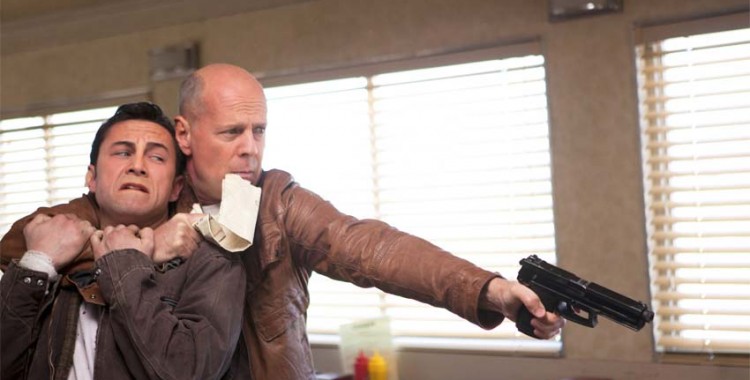
Based around the mob's use of time travel to send their victims and enemies back in time to killed, 'Loopers' are the ones who act as their executioners. Eventually though the Loopers themselves begin having to kill themselves, having been sent back 30 years from the future, equipped with a massive pay off, to make sure they enjoy their final 30 years. One day though, one of the Loopers (Paul Dano) discovers it's his future self before pulling the trigger and lets his future self go. Now on the run from the mob, the Looper seeks refuge with his fellow Looper (Joseph Gordon Levitt), who resolves to give him up. This leads to one of the film's best moment, as the exiled Looper from the future is dismantled by the mob who are 'operating' on his younger self. There is also this whole "seemingly" superfluous mention of telekinesis, that gives one that sinking feeling about where this film is heading.
Soon Gordon-Levitt's character is brought face to face with his own future self (Bruce Willis), which leads to another fantastic sequence showing the different 'loops' and the consequence of the character killing himself (when it originally happened the first time his future self was sent back). Up to this point the story and action is extremely absorbing, as Willis tries to kill the future crime lord who he has deduced is a 5 year old child, and Gordon-Levitt tries to kill his loop. The film doesn't hold any punches and is also pretty unconventional.
Sadly it is right after this point where the film falls apart, in a similar fashion to the earlier character who was literally dismantled. The film quickly begins to become overindulgent in the melodrama; and even the action sequences become gratuitous, even to the point of laughable. I honestly can't remember a movie having such an abysmal final third in contrast to the rest of the film. The twists are predictable, which is I don't usuallly have a problem with, but in this case they are executed poorly and one soon becomes irritated with how poorly they're handled. For a film that started so well (though obviously nowhere near The Matrix level of greatness) it's ending is so shockingly awful, that you have to remind yourself it's the same movie. Bruce Willis' own Twelve Monkeys is similar in concept, but the finished product there is far more satisfying compared to this below average affair.
Next up I saw A Star Is Born, one of Judy Garland's most famous films and one made off the back of many similar movies that were about the show business industry. It was later remade in the 70's with Barbara Streisand in the lead role; but this version was itself in fact a remake, however this is the most famous version of the film. It was significant for Garland as it was the first film she made with Warner Brothers, having successfully terminated her contract with MGM. As such what is most striking about this picture is Garland's image, as she appears more dowdy and plain; but this is also due to the script, which satirises the "star system" (synonymous with her old employers MGM). Her image may have also been suffering due to her off screen drug troubles and mental illness.
The film itself centres around Esther Blodgett (Judy Garland), a small time singer, who's show is interrupted by A-lister Norman Maine (James Mason), who drunkenly invades the stage. He soon sobers up and spots Garland singing in a lounge bar, where he's struck by her talent. He soon sets about in making her a star and the two fall in love along the way. The problem at this part of the film is that Mason's character when they first meet is such a wreck that it's hard for the viewer to warm to him quickly. To be fair to Mason though, he's seemingly unscrupulous character, begins to show some heart as he falls in love with Garland.
The film is credited as being Garland's landmark performance, and whilst she is undoubtedly the star of the show, it is neither a performance that completely blows me away. She has that sense of vulnerability and charm that makes her endearing (along with her singing talent), but the lack of great songs and plaintive tone of the film, doesn't work in favour of her performance. As for Mason, he lacks a bit of the charm and suaveness he exudes so readily in other pictures, oddly enough it's his plaintiveness that does work for him in this film; and his ability not to conform to the conventional leading man is arguably his greatest strength. There is also decent support in this film from accomplished actors Charles Bickford, Jack Carson and Tommy Noonan.
The production values are also strong, and atypical of the musical's of the 50's; with direction from the great George Cukor, and musical arrangements from George Gershwin's brother Ira. Unfortunately, the film on the whole comes up short, in terms of both films of similar plots such as Singin' in the Rain, All About Eve, Sunset Boulevard and even The Bad and the Beautiful. It's lack of real great show tunes and musicality even leaves it short in my opinion of the being a truly great musical. It's a good film, that is maybe over indulged by fans of Garland, who are exposed to an on screen Garland that is akin to her real life turmoil. The film in truth though is a bit too overblown for it's own good.
Don't Look In The Basement was an early 70's horror film, much in the same mould of the low budget grindhouse and snuff movies also released around that era. This film did in fact share a double bill feature with Wes Craven's The Last House on the Left. Set in a remote mental asylum, where a couple of the patients have killed a doctor and a nurse, leaving just one more doctor on site, when a young female nurse arrives informing the doctor that she was assigned to the place by one of the victims. This nurse begins to endure the mental and physical anguish the patients unleash on her.
Whilst this film is very low budget, it is blessed in that it has a strong plot, that does suffer a bit from slightly erratic direction at times, that can sometimes seem confusing. The acting is also forgivably tolerable, but does suffer from a bit of the usual woodenness associated with these pictures; but at the same time is amusing and is why they're so enjoyable. In my opinion it does compare favourably to other films of the genre, and is definitely amongst the better ones I have seen. It isn't overly gratuitous and has a bit more purpose than the snuff-centric The Last House on the Left, but it's not quite as gripping as I Spit on your Grave. The ending to this one will leave the viewer guessing, and it's probably due to it's strong screenplay that a remake is currently in the works. However, there's something about the rawness of these films, that make the overproduced remakes occasionally pale in comparison to the originals. The entire film can be seen below:
I also watched the 1925 version of Ben-Hur: A Tale of Christ, which is often cited as being the most expensive silent film ever made. Though it shared much the same narrative as the Wyler remake, there were also longer, as well as a few additional scenes. The film was directed by Fred Niblo, who had directed two other movies I had seen, Greta Garbo's The Temptress and Mysterious Lady. Already impressed by hints of his technical mastery in those pictures, this film is undoubtedly his most known, probably because it's his most impressive. This was one of the first MGM productions, it's opulence and grandeur would serve as a signal that started MGM's and indeed Hollywood's Golden Era. Along with The Big Parade, Ben Hur instantly propelled MGM to become the biggest studio in Hollywood.
Niblo had originally wanted to cast Hollywood's biggest star at the time in the title role, Rudolph Valentino. Eventually the role was given to Ramon Navarro, who gives an interesting performance as Ben Hur, and looks the part, especially when enslaved by the Romans. The problem is though, that Charlton Heston's seminal interpretation of the character is definitive. his characterisation best portrays Hur's inner struggle with faith and vengeance. Whilst the supporting cast, especially Francis X. Bushman as Messala, work well; they don't quite match up to the charisma and emotional impact the modern cast portray.
The film also differs to the remake in it's tone; this film is surprisingly darker and even more subversive than the 1959 version. It includes scenes of nudity; and the violence is also quite graphic for a film of the era, most notably during the galley battle and of course the chariot race. Despite this, rather ironically, the film managed to pass censors as it was about Christianity. One can't talk about Ben-Hur: A Tale of Christ and not mention the chariot scene. The original version is just as impressive as the later one; maybe more so as it was filmed more than 30 years earlier. Interestingly one of the second unit directors in this scene was one William Wyler. This version also boasts the restored 2-colour Technicolor footage, originally though lost. The colour footage looks incredible and adds to the film as a spectacle. One of which stands out more than the others, which parodies Raphael's masterpiece The Last Supper. Finally, like the majority of restored silent films today, this version boasts a score from the always impressive Carl Davis, who's work has ensured the projects he's worked on will endure for a further 90 years.
Overall, I believe Wyler improved upon this version, mainly due to the cast and the fact that the sound does add to the emotionally charged script (admittedly, some of the best lines are taken right out of the original). This however, is undoubtedly a great epic, and one that will forever be remembered for it's ground breaking technical direction from Niblo; which in turn propelled MGM straight to the top. The resulting Golden Age of cinema and it's "more stars than heaven" owe a lot to this film; even if it took until 1931 for it to make a profit, it was still very much a box office smash and great success for MGM.
The Public Enemy was my second James Cagney film after his sensational turn as psychopath Cody Jarrett in White Heat. The Public Enemy was made 18 years before that film, and would forever be remembered as the film that made James Cagney a star. People have often cited the moment that James Cagney appears on screen in The Public Enemy as the birth of modern acting. It's easy to see why too, he's comfortably natural in front of camera, noticeably more so than some of his co-stars. Added to that the energy and charismatic performance of Cagney, it's easy to see why the world fell in love with this despicable on screen character. He plays a young Chicago hoodlum, who soon becomes murderous and one of the forerunners for bootleg alcohol during the prohibition period.
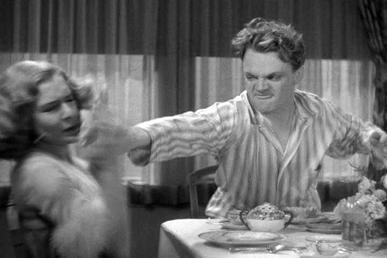
The charm of this film is that it is made just a few years before the Hayes code came into effect into the Hollywood. Therefore we are privileged to see a more open reflection of the Chicago the film is set in, including a highly camp and suggestive tailor, Cagney getting seduced by a floozy whilst drunk; along with more brutal and violent scene, including the infamous "grapefruit scene" with Mae Clarke. Also in this film is another icon of cinema, Jean Harlow. Harlow was given second billing in the film due to her association with Howard Hughes and the success of the recent Hells Angels. I like Harlow's look, and whilst she isn't particularly beautiful, she has a unique style that is unmatched and an allure different to her contemporaries. Unfortunately in this film her performance is rather flat and she seems to struggle with the delivery of her lines; along with limited screen time. However, it is great seeing two screen icons sharing the same scenes.
The film is superb, despite it's flaws, and is one of the greatest gangster films I've seen, predominantly because of Cagney. His ability to be both terrifying, yet endearing is a real gift; the story is also gripping, and one that future films of the genre would follow. For a film that is now over 80 years old, it holds up remarkably well, and for anyone who likes crime dramas, it's hard not to enjoy this.
Man on Wire documented Frenchman Philipe Petit's audacious stunt of tightrope walking across the World Trade Centres in 1974. It's a film that intersperses that big stunt, with footage of Petit's build up to it; where we watch him hone his skill and performs similar stunts on Notre Dame Cathedral and across the Sydney Harbour bridge. We also see the formation of the relationships with the people that would help him pull of the stunt, the most notable of which are with his fellow planner Jean-Louis Blondeau and his girlfriend Annie Allix.
Whilst the documentary is always intriguing, it really reaches it crescendo when it talks about the World Trade Centre stunt. The intricacies of how they put the wire across a 150 feet gap, is clever and admirable. When the moment comes towards the end of the film, it's truly awe-inspiring, one gets vertigo just from the idea of it. It isn't just Petit, the viewer ends up admiring, but also his support team. Their complete calm at seeing their companion do this truly death defying stunt would be hard for even the most of benign of person would struggle to convey in such a situation. Jean-Louis' pragmatism is the perfect antidote to Petit's dreamer like persona, and one can't help but feel this was needed to ensure Petit wouldn't go too far and be killed.
It is after the stunt is performed that we realise Petit is quite a selfish individual, as he takes the plaudits and is seduced by the power of his new found fame. We are left just as betrayed as Jean-Louis and Allix, as they are left abandoned after the stunt. Nonetheless one can't help but respect these people who push the boundaries of plausibility and produce just one extraordinary moment, that shows the true power of man.
In anticipation of next month's release of Skyfall, this is the final James Bond entry celebrating the 50 years.
My Favourite "Bond... James Bond": Daniel Craig in Casino Royale
The furore over the casting of Daniel Craig as James Bond was well and truly silenced with his debut in Casino Royale. There have been many Bond introductions that are instantly iconic as each new actor takes on the Bond role, none more so than the original opening lines Sean Connery uttered 50 years ago in Dr. No. However, as iconic as that moment is, I think it was superceded by Craig at the end of Casino Royale, as the darker tone and mood of his Bond was truly cemented as he shoots Mr. White in the closing scene of this movie. It's a fantastic way to end Craig's arrival as Bond and is entirely fitting and appropriate in the context of the film and his interpretation of the character.
My Favourite Bond Death: Jill Materson in Goldfinger
Obviously there are a number of great deaths in the Bond catalogue with Tracey di Vicenzo tragic end in On Her Majesty's Secret Service, to Franz Sanchez's associate's Krest's sickeningly explosive end in License to Kill. The most iconic of all of these those has to be Jill Materson's death in Goldfinger, considering it's a relatively small part for a Bond film, Shirley Eaton who played her is still recognised today for her role. It was probably the death that set the tone for all future Bond's in killing people in unique, over-the-top and slightly gruesome ways. Materson's crime, was helping Bond cheat Goldfinger at cards, and so suffocated in gold paint, in a scene that has echoes of Caligula's downfall. My Favourite Bond Film: The Spy Who Loved Me
This was incredibly tough, whilst the Bond series isn't the most consistent, when it's good it's great. Whilst I do thing From Russia With Love, Goldfinger and Casino Royale are great films in their own right; and Thunderball, The Living Daylights and Goldeneye are entertaining; I think The Spy Who Loved Me is the one that combines all the great Bond elements. It has great gadgets, the fantastic submersible Lotus Elise, a fantastic looking Bond girl in Barbara Bach, a brilliant villain played by the great Kurt Jurgens and even Roger Moore gives one of his best Bond performances. I don't know why I ended that sentence there because there's also Jaws, a superb Carly Simon theme song composed by Marvin Hamlisch and a superb screenplay. It was the film that probably helped rejuvenate Bond, in the same way both Goldeneye and Casino Royale later did. The film also combines great chases and action against the backdrop of impressive set pieces, like the Sphinx at Giza and villain Stromberg's Atlantis water fort. The film was directed by British stalwart director Lewis Gilbert, who was also at the helm of Alfie, Sink the Bismarck! and another Bond film You Only Live Twice. Which makes him close to Martin Campbell in terms of directing quality Bond films. The film sets the fast paced tone from the start, with an impressive opening scene (below). I think it's the most balanced of all the Bond films, and as such is quintessential.
My Favourite James Bond: Roger Moore
While I think most people agree the quintessential James Bond has to be the first interpretation with Sean Connery; for me the one that fits ultimately with series, and indeed helped the franchise survive a difficult transition period, has to be Roger Moore. Whilst the standard of his films weren't always up to scratch, I feel he is the most representative in that aspect of the inconsistency of the franchise. As well as that I think he also gave the most variation to the character, in his films he would show to chauvanistic side of the Bond character, which now seems slightly too politically incorrect, maybe cause it is the usually charming Moore being violent to women. But with that he was also the funniest Bond, albeit not always for the right reason. I think the Bond does have a strong sense of kitsch, even in the Connery era, but because Moore represents this aspect so well, for me personally he's most representative of Bond.
In fairness to everyone who's played Bond, everyone has held their own. Even though Lazenby for a time was largely lampooned by the wider audiences for his portrayal, I think it's fair to say that On Her Majesty's Secret Service was one of the best Bond films and that was in part to Lazenby's ability on screen. His breaking down of the "fourth wall" at the start, whilst controversial, in my opinion it's almost like the definition of kitsch, but it's so bad it's in fact good; I think it's those moments in the franchise that make Bond what it is. Dalton and Brosnan are other ones that are often the victims of criticism, but what is great about the Bonds is each have their own unique interpretation and none of them really attempt to copy another.
As for Moore, one thing that I think is most unappreciated about him is that he was able to keep Bond going through a tough transition. Whilst he himself admits he continued for too long, I think it's fair to say that he did a great job in keeping the franchise alive especially with films like The Spy Who Loved Me and For Your Eyes Only, when EON were really struggling financially and with rights issues. Another thing that is likeable about Moore is his openness and willingness to talk about the franchise and the ability to poke fun at himself. He starred in 7 movies overall, the most of any Bond actor, and whilst the quality wasn't always there, each outing had the same sense of fun and incredulity that has since become synonymous with Bond, that in most cases it's forgiveable. Barry Norman has said that "Everyone's favourite Bond is always their first". I'm not sure this is true, as I believe the majority would say either Connery or Moore, which is understandable as they are responsible for over half the franchise. I also believe that there is a high proportion of people like myself who recognise Connery for his greatness as Bond, but at the same time hold a great affection for Roger Moore's own self-styled Bond.
Preview: Skyfall Having now seen the trailer for Skyfall on the big screen, I think it's fair to say my anticipation level has heightened slightly. It seems like a superior film to the disappointing Quantum of Solace and maybe a return to the standard of Casino Royale. There seems a lot of action though with some impressive looking stunts, with this comes the fear that the screenplay and writing will suffer. Though with a cast that includes Javier Bardem, Ralph Fiennes, Rory Kinnear, Naomi Harris and the great Albert Finney, it's hard to see it falling short. It's also interesting to note that Finney becomes the first actor to have both a role in the Bourne and Bond franchise, but with Finney being an actor with such a variety, it may go unnoticed by many. Below is the trailer for Skyfall:
Bond at 50: On Blu-Ray
Below is a trailer celebrating the October 5th release of all the Bond movies on to Blu-Ray:
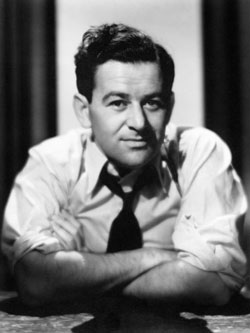
When talking about greatest film directors of all time the names John Ford, David Lean, Billy Wilder, Martin Scorcese, Federico Fellini, Stanley Kubrick, Stephen Spielberg and Akira Kurosawa are all likely to be mentioned among others. One name that probably slips through the net more often than not is William Wyler. In fact he probably isn't as assosciated with his own films as much as his peers are with theirs. The films of Ben-Hur, Wuthering Heights, Funny Girl, Roman Holiday and The Best Years of Our Lives are all synonymous with American 20th century cinema and remain popular today. The average movie goer however may be unaware that they are all the output of one man.
Born in the Franco-Germanic region of Alsace in 1901, Wyler was always destined for a career in movies. His mother's cousin was the founder of Universal Pictures, and it was through this connection Wyler went to try his hand at forging a film career in Hollywood. First though he arrived in New York to serve as a messenger for Universal Pictures, not to mention also working for New York's Home Guard. He did this for but a few years, before moving on to Hollywood to work as a stage hand and runner for Universal Pictures. He didn't impress early on, with legendary producer Ivan Thalberg nicknaming him "Worthless Willy" due to his lack of work ethic. He got a break and moved into editing, before becoming a third assistant director and eventually by 1925 beginning to direct his own shorts, and thus becoming the studios youngest director. In his early career he was mainly specialising in non too impressive Westerns.
In 1928 he became a naturalised US citizen and began to direct his first non-Western pieces as well as new pictures utilising the advent of sound known as talkies. By now he was beginning to master his craft with popular films that were bringing in strong box office takings for Universal. One of which was called Hell's Heroes, Wyler's first full sound film and a great success upon release.
It was also at this time that his infamous reputation for multiple takes began to take shape. Though this technique would seem to garner impressive and adulating performances from his actors. The Good Fairy starring Margaret Sullavan (who he married in 1934) was his last film for Universal, and probably his best received up until that point. In 1935 he struck up a collaboration with another legendary producer, Samuel Goldwyn. It would prove one of the most prolific film creating partnerships in cinematic history.
Their first film Dodsworth was quite revolutionary in the time of Hayes code in dealing frankly with the subject of a failed marriage. It naturalistic and believable acting is testament to Wyler's ability with his cast, and the film won wide critical as well as box office acclaim, earning Wyler his first Best Director nomination. He followed this up with a less controversial version of the lesbian themed "The Children's Hour" called These Three, he would later remake this in it's original form with Audrey Hepburn and Shirley MacLaine in the lead roles. His next film Dead End, proved another hit, featuring Joel McCrea and Humphrey Bogart in his pre-leading man gangster role. It was again received well commercially and critically, this would again continue with his film Jezebel featuring Bette Davies and Henry Fonda. Jezebel is still well regarded to this day, namely for Bette Davies' Oscar winning performance in the lead role, that helped cement her as one of Hollywood's most strong willed leading ladies. It would also mark the start of a very successful three film collaboration with Davies, that culminated in 1941's The Little Foxes.
1939 saw the production of one of Wyler's most famous films and the most celebrated screen adaptation of Emily Bronte's Wuthering Heights. For the lead role of Heathcliffe, Wyler cast one of the most lauded acting professional's from the West End stage. Laurence Olivier had been to Hollywood in the early 30's, but was unable to make his mark on the film industry, and so returned to London. In 1939, his new girlfriend Vivien Leigh was cast in one of cinema's most sought after roles as Scarlett O'Hara in Gone With The Wind. This marked Olivier's return to Hollywood, and Wyler provided him with his first role opposite Merle Oberon. The film was another success for Wyler as both he and Olivier earned Oscar nominations. Olivier credited Wyler, for helping to believe in the art of film acting, as Olivier had previously struggled with the concept. His performance in Wuthering Heights is widely regarded as one of his best. He would go on to be remembered as one of the acting greats, and even worked with Wyler once more in the largely underrated Carrie in 1952.
Such was Wyler's brilliance that despite this influx of success and fortune, he didn't let up and continued to make films of a high quality. In 1940, not only did he direct The Letter but also achieved success directing Gary Cooper in The Westerner. After 1941's The Little Foxes he made Mrs. Miniver, which earned both himself, Theresa Wright and his lead Greer Garson an Oscar each. The film was not only a critical success, it was highly influential in galvanizing support for the British in the backdrop of their war against Nazi Germany. Though President Roosevelt was very keen to aid Britain, and indeed sent aid packages across the Atlantic. General consensus amongst Americans at that time was they didn't want to get involved in someone else's War again. British Ambassador Joseph Kennedy went even further when he wrote a letter to Roosevelt informing him to give up on Britain. This in itself also had the reverse effect on the American's who felt it was ungentlemanly and cowardly of Kennedy to abandon his British post. Nonetheless, Wyler's film served it's own part in shifting public opinion on the war in Europe before Pearl Harbour.
As Wyler's reputation grew, so did his legend, especially his "90 takes Wyler" label. During the shoot of Jezebel, Henry Fonda got through 40 takes, before asking for what was wrong, Wyler simply responded by saying "It stinks.". His perfectionist style though garnered the best out of his performers and his performers would eventually come round to his criticisms and methods after seeing the finished article (and winning awards). His style has been adopted by other great directors such as Stanley Kubrick, and to similar effect.
The war proved an interesting period for Wyler as he served as a Major in the United States army. He produced two documentaries on the war in this period, at great personal risk to his safety. Whilst making a documentary on The Memphis Belle as he filmed devastation over enemy territory and even one time passed out from a lack of oxygen in his cabin. One of his cinematographer's was shot down and perished during filming too. Wyler would also lose hearing in one of his ear's due to the loud sound produced from his plane's engines.
The war had a profound effect on Wyler and inspired him to create another masterpiece with The Best Years of Our Lives. It centred around the lives of three homecoming veterans and their struggle back into civilian life. An emotionally charged film, it perfectly captured the mood of not only post-war America, but also the whole world after the effects of the war. The film also featured real life veteran and amputee Harold Russell as one of the three veterans; and despite no formal acting training, Russell would win two Academy awards for his performance. The Academy considered him an outside chance for the Best Supporting Oscar that they gave him an honorary award on behalf of the Allied veterans, but he went on to win the other Oscar regardless. Wyler himself also won his second Best Director Oscar, and his ability to create acting performances was given further credence as Frederich March scooped the Best Actor Oscar. It was a hugely personal film for Wyler, and is still today recognised as one of the great war films, for it's ability to humanise the aftermath of the war so well.
In 1949, Wyler returned to the more traditional plots of film-making with The Heiress. It featured Montgomery Clift as a swindler who tries to manipulate the naive and mousy Olivia De Havilland for her money, her father played by Ralph Richardson suspects from the outset and forbids his daughter from seeing him. Olivia De Havilland produces the performance of her career as the woman emotionally abused by the two men in her life. Her performance was possibly helped by the real life snide remarks she received from her co-stars, as well as Wyler's own demanding regime. The film was quite different for it's time and a little subversive, it again showed Wyler's ability to create well made and popular films.
Wyler's next two films though very good and moderately successful, are largely forgotten today. 1951's The Detective Story was a crime thriller starring Kirk Douglas which centres around a police precint and the already mentioned Carrie with Olivier and Jennifer Jones. Though both these films had moderate moderate success at the box office.
The film that followed these though was to become a classic. In Roman Holiday, Wyler cast the then unknown Audrey Hepburn as the European Princess seeking adventure on her own in the real world, where she meets Gregory Peck, the newspaper journalist who believes he's got the scoop of his life. Arguably Hepburn's best movie, it beautifully captures a wonderful love story against the backdrop of the beautifully captured Rome. It earned Wyler yet another Oscar nomination and secured the Best Actress Oscar for the new star Hepburn.
In 1955 Wyler cast Humphrey Bogart in one of his final film roles, opposite Frederich March in The Desperate Hours; as well as making Friendly Persuasion which earned the director his first Palme D'Or at Cannes. 1958 saw Wyler return to the Western genre after a near 30 year absence, in broadly scoped The Big Country. Wyler cast Peck again as a retired ship captain who has relocated to the American west to marry his fiance (Carroll Baker) and meet the approval of her father (Charles Bickford, who Wyler had worked with 30 years earlier). Possibly one of the most underrated Westerns ever, it is also one of the few pacifist Westerns. The film also featured another key moment that would influence Wyler's next film when he cast Charlton Heston as young ranch hand Steve Leach. Folk singer Burl Ives also received the Best Supporting Actor Oscar, laying further claim to Wyler's uncanny ability to produce great performances from his cast.
Having broadened the cinematic scope of his films with The Big Country, Wyler's next project was even more ambitious. Having originally wanting to cast Peck again in the lead role, but reverted to Heston after Peck dropped out. It was an inspired choice for both parties. Heston had initially been reluctant to even do The Big Country due to the role not being big enough. It is somewhat ironic that it would eventually lead to the biggest role of his career and the one most people still remember him for in the remake of Ben-Hur. Wyler had worked as an assistant to Fred Niblo in the equally impressive silent version. Other interesting notes in project's development was that the screenplay had been partially written by the great playwright Christopher Fry, as well as the great novelist Gore Vidal.
Ben-Hur was a huge project for Wyler, and many doubted whether he could produce a film of Cecille B. De Mille proportions. It is, arguably now considered better than anything De Mille ever conceived. Whilst maintaining a lot of what made the original silent so popular, Wyler even managed to improve these aspects. Most notably the chariot race, which featured some of the most realistic action sequences ever commited to screen art that point. Later directors such as Ridley Scott have commented on the incredibly scale of the set pieces used by Wyler in the picture. Scott even compared his own CGI in Gladiator as a pale imitation of the physically constructed sets used in Ben-Hur.
The film was a monumental success for Wyler, and earned a record 11 Academy Awards, including another one for best director; as well as two more acting awards, including Best Actor for Heston. The film has lost none of it's power since it's release and is often a stalwart during the holiday season on the television schedules.
As Wyler grew into his 60's his output began to lower slightly, but his quality ceased to diminish. In 1961 he remade his own film These Three, to include the more subversive tones of the original play The Children's Hour. It was the second film he made with Hepburn, who played one of the accused, along with Shirley MacLaine, of being a lesbian by one of their students. Though not as successful award wise as Ben-Hur, it again achieved mass critical acclaim and was a notable entry in Wyler's career at his ability to mould his movies to feel the vibe of his film contemporaries.
His next film was the even more subversive and morbid The Collector, which again has been somewhat overlooked, but earned Wyler yet another Best Director nomination. A very intimate film, it told the story of a man (Terence Stamp) obsessed with beauty in a dark and sinister fashion. The film has served as a point of origin for many disturbing thrillers since, most notably The Silence of the Lambs.
In 1966, Wyler teamed up with Hepburn for a third and final time, this time opposite the great Peter O'Toole. Here she plays the daughter of an art forger who teams up with O'Toole in order to steal a museum statue and conceal her father's fraud. A light hearted caper, it serves as yet another example of Wyler's unique ability to tackle any project with a remarkable sense of knowing. Though not as much a critical success, it has managed to survive the years and is still fondly remembered for it's sense of fun and the solid performances of screen idols Hepburn and O'Toole.
Two years later, Wyler was assigned to direct his first musical of his long and illustrious career. It was to serve as a vehicle for it's star, who had already conquered Broadway in the same role, Barbara Streisand. Wyler has initial reservations about the film, due to his loss of hearing, but decided to take it as he enjoyed the challenge. He espescially commented on Streisand's untraditional lead lady looks. Here she played comedienne and stage star Fanny Brice and centres on her turbulent relationship with Nick Arnstein (played by the always immaculate Omar Shariff). Despite the "challenges", the film was yet another bonafide success for Wyler and it's stars. It propelled Streisand into a global megastar as she won the Oscar for Best Actress. An incredible feat for a movie debutant, that is as much to do with Wyler as it was Streisand.
In 1970 Wyler made his last film, which again was a complete change of tone for the master of variety. Another dark film that tackles the issues of racial prejudice and bigotry in small town America. The film wasn't much of a critical or commercial success, perhaps as it had arrived too late in relation to other potent civil rights related films. But perhaps it is fitting that Wyler would end his career, with a film so on a tangent in relation to the other films in his cannon.
Wyler retired from Hollywood and largely remained quiet in his final year. Having received the Thalberg Oscar for outstanding Lifetime Achievement by the Academy in 1965, he was then awarded the AFI Lifetime Achievement award in 1976. In 1981 he gave a retrospective interview for PBS called Directed by William Wyler, with his daughter Catherine. He died from a heart attack three days after film, at the age of 79.
The man's legacy though is without question. Having earned 12 Academy Award nominations and 3 wins for Best Director, as well as a Lifetime Achievement award, he is one of the most decorated directors of all time. The most supportive claim to his legacy of greatness is the fact that he has directed more actors to Oscar nominated performances with 36; 14 of whom went on to win their Awards, than any other director in history. He was married twice, briefly in the mid-30's to actress Margaret Sullavan, before marrying Margaret Tallichet in 1938 and spending the rest of his life with her.
It seems incredible that this man with such humble European beginnings would go on to truly conquer Hollywood. The greatest compliment that can be paid to him as a director, is that some of his films aren't instantly recognisable as a Wyler flick. Such was the man's range and skill; it really is hard to believe that the man could achieve such great results in such a wide variety of genres and types of films. In an age where film critics and historians tend to concentrate of the auteurs of the industry (Kubrick, Tarantino and Renoir) as being the benchmarks of greatness in the field of direction; Wyler is the exception to this. His ability to work with studios and conform to certain styles and methods, whilst at the time exerting his own influence, is something that is confounding to some. Surely a sign of true greatness?
Red Planet was a film with an interesting enough plot synopsis that I thought it would be worth ago, despite it's less than favourable reviews. Centring on the first manned mission to Mars and their efforts to terra form the planet in order to rehabit the Earth, I was expecting something a bit more high brow. Instead I was provided with the same generic Sci-Fi Action movie that has seemed to plague the genre since the 80's. What was made worse is that usually in these films there's the same mix of the group of characters central to the plot; but in this all the characters were exactly the same two dimensional replicas of each other. This was made worse by the atrocious dialogue written for them. I would feel sorry for the actors involved, but they seemed to revel in their roles of the arrogant driven types with the false sense of bravado. Even Terence Stamp's lack of humility in delivering inane line after inane line cannot be forgiven. The worst offenders are two of the biggest stars Val Kilmer and Tom Sizemore, who provoke the viewer into wishing they would never have to watch another film with them in.
As the film progresses though there are glimmer's of hope for it, as the plot takes some interesting twists, but it also suffers in the fact that when the action happens some of the CGI effects look quite dated. The CGI for AMEE, the AI robot that's been assigned to the mission, does manage to look okay until it starts attacking the cast (which is a saving grace in itself). It's a shame though that films like these aren't remade, as there really isn't much to be lost in redoing this as opposed to a remake of Total Recall. The film's essence has potential, but sadly all the ingredients used to turn the screenplay into a movie have proved disastorous, and this film doesn't end up offering much in the way of a entertainment nor originality. I suppose the most irritating thing about this film, is the knowledge that it had such a large budget and you're left wondering how and where it was spent.
Fred Zinneman's A Man For All Seasons with Paul Scholfield as the saintly Sir Thomas More, torn between the role of serving his king or serving his God. It's film that perhaps doesn't resonate with the state of today's secular society, but it is a great tale of a Godly man which still shows the important role of religion and morality in the world not only then, but now. Legendary playwright Robert Bolt delivers one of his most fascinating screenplays for this film as the tensions between More, King Henry VIII and Thomas Cromwell come to a head. Robert Shaw delivers a typically strong and charismatic performance as the obstinate King Henry, Cromwell by the reliable Leo McKern. An impressive cast is completed with a young John Hurt as the pivotal Richard Rich and Susannah York as More's daughter; along with cameos from Orson Welles as the late Cardinal Wolsey and Vanessa Redgrave as Anne Boleyn. It is really though all about Schofield who provides an exceptional performance as the man who stood up for his own beliefs and followed his own moral compass at risk of his own demise.
Whilst the film isn't as gripping as maybe Becket, it is yet another great example of the terrific output of cinema during the 1960's. It's yet another impressive movie from Zinneman and Bolt and is a fantastic portrait of one of history's few good men.
I then watched my first ever movie starring one of early cinema's biggest icons: Jean Harlow. Platinum Blonde was early Columbia picture, directed by Frank Capra, the man that would propel the studio to the mainstream a few years later with It Happened One Night. Although this film was released after her career defining Hell's Angels and The Public Enemy, it was made before Harlow had become a mainstream megastar, which is probably why she plays a slightly different role to her usual type.
The film is about a reporter (Robert Williams) trying to get a scoop on a wealthy socialite's (Harlow) family's misdemeanours, instead he falls in love with her and they elope. His colleague Gallagher (Loretta Young) is in love with the reporter and is heartbroken when she learns of their marriage. Meanwhile the newly weds each try to change each other to how they want them to be, with him wanting her to be his obedient wife and she wanting him to become a gentleman and a playwright. Whilst the film does come of as a bit dated in some places, the story is still enjoyable and engaging enough for today's modern audience. The acting is pretty decent for an early talkie, although one can't help but think the film would have worked better with Harlow and Young switching roles. Harlow seems beyond her age of 20 in this role, but she is very cute in this role, and her voluptuous figure is reminiscent of Mae West, which probably isn't befitting of 1930's socialite. Loretta Young is equally beautiful, even though she is stuck in dowdy clothes for the most part.
The biggest tragedy is watching the film knowing the untimely death of it's star, not Jean Harlow who would die just 6 years after this film, but Robert Williams, who died just after the film's release. He manages to carry the film where needed, and is similar in style to Cary Grant. It seems a shame that he would die at such a young age, as no doubt he would have gone on to a successful career as one of Hollywood's leading men. The film also has the early hallmarks of a Frank Capra picture, with all the witticisms and fast paced progress that his future films contained. Admittedly, the comedy is slightly laboured and dated at times. Overall though it is a decent film that serves as a launchpad for me to watch more of Harlow's films.
The Great Gabbo was an early talkie that featured a starring role for the great director Erich Von Stroheim. The film is heavily referenced in an episode of The Simpsons, and as such isn't as forgotten as the majority of film's of this ilk from this era. The quality of the film isn't great as it's degraded understandably over the years, and 26 minutes of footage is missing (including early colour footage), which is unfortunate. Having said that though, the movie is decent, and features some good acting, especially for an early talkie.
Von Stroheim shows us that he wasn't just meticulous director, but also a meticulous and accomplished actor also. He plays the title role as a ventriloquist, who becomes tired of being upstaged by his incredibly life like dummy. It's hard to understand whether Gabbo is just a great ventriloquist, or Otto does have a life of his own. Equally one could come to the conclusion that Gabbo is quite literally mad and is a borderline schizophrenic with Otto serving as his other half.
It is very unnerving movie, which is heightened with each time Gabbo and Otto appear on screen. This is a credit Von Stroheim, who is one of the few actors to be able to create such intensity in these early days of Hollywood. It's also interesting that Ben Hecht wrote the screenplay, a man who would go on to write some of the great screenplays for both MGM and Hitchcock. The film does try to utilise it's sound a bit too much, with plenty of musical numbers, which come across as superfluous in places, but are quite visually impressive. Nonetheless, it's an interesting film (thanks mainly to Von Stroheim), that would possibly be even more highly regarded if fully restored. The entire film can be viewed below:
F for Fake was a documentary produced and starring Orson Welles. It focused on the art of fraud, specifically centring on the story of Clifford Irving and how writing a biography of the great art forger Elmyr De Hory, inspired him to write the most infamous biography of the 20th century.
Of course, I had already been fortunate enough to watch the adaptation of Irving's publication of the fake Howard Hughes biography in 2006's The Hoax. This probably helped me understand a lot of the information Welles was presenting in this film, concerning Irving as a person and his motivation. However it is De Hory's forging of art's great masterpieces that produces the most intriguing debate on the morality and legality of such hoaxes. Without doubt Elmyr is an artist with incredible skill and technique; his ability to recreate works by Matisse, Modigliani and Renoir is astonishing. Welles rightly questions whether instead of criminalising him, we should laud him. Though this film tends to do just that anyway. It was also nice to see Welles make reference to his own infamous hoax: his 1938 radio broadcast of H.G. Wells' War of the Worlds, which sparked mass panic and hysteria across America, But it isn't only these three characters that cause such fascination with their enigmatic and evasive characteristics. Howard Hughes himself is perhaps the most enigmatic and certainly the most evasive of this film's cast. Hughes had his own penchant for trickery and showmanship, using his own doubles, his pioneering work in the aircraft industry; even with the in question biography, some believed Hughes has perpetuated a lot of the hoax himself in order to pressurise then President Richard Nixon.
It is a captivating documentary that goes one step further (arguably one too far) at the end. Even so the final segment is still spellbinding due to Welles' own art of storytelling, as well as the theatrics. It may not be to everyone's taste, but people with a sense of admiration for those who achieve infamy through undiscerning routes, will be swept away by the deception. It is a film that is emblematic of Welles as a person and a film maker, which is a compliment to this documentary.
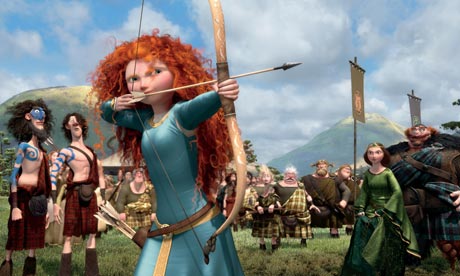
I finished the month by watching the latest Pixar offering Brave. It was an interesting take on the princess stories, with a tomboy Scottish princess (Kelly MacDonald) this time trying to take her destiny into her own hands. Sadly the concept was the best thing about the story, as the film resulted in being a bit of a jumbled mess, and not nearly as captivating as the majority of Pixar's output.
Granted, the animation was magnificent, but I'm afraid that Pixar, and for that matter animation, has gone beyond being just well animated to be regarded as good; it needs to be backed up. The film also has a strong and talented British cast, but here their voices don't lend much to the film, possibly because their characters lack enough depth to make them engaging. The one character that really goes well with the movie is The Witch played by Julie Walters. The rest of the film seems to be stuck in limbo, as it seemingly attempts to be a cross between Princess Mononoke and Braveheart, but pales in comparison in almost every aspect. There are some murmurings that Pixar are on a downward trajectory, but I think that's a bit unfair, as unfortunately they may be becoming victims of their own success. Unfortunately, the majority of their film's are seen as some of the greatest of all time in terms of animated features, and rightly so.
My first film in August was Little Voice, based on the stage play that was written specifically for Jane Horrocks. It tells the story of a shy, reclusive woman who has a great passion for the songs of Shirley Bassey, Judy Garland, Marlene Dietrich and many other classic singers. One night a local night club promoter (Michael Caine) overhears her singing the classic songs herself and sets about in making her a star.
Whilst the films is ultimately an over sentimental account of a decent premise, Jane Horrocks is very impressive as she performs all the songs herself. She manages to mimic the great stars to a very high standard and is easily the best the thing about the film. The problem with the film, is that it tries far too hard to play on the emotional side of the story too hard. The acting whilst reasonable, did make me cringe at times as the actors, who consisted of cast of British stalwarts (Ewan MacGregor, Brenda Blethyn and Jim Broadbent), tried too hard to present themselves as simple small town folk. It made the film a bit shallow at times, and was endemic of the majority of late 90's feel good British movies. The problem was though, it wasn't as good as films such as The Full Monty, East is East and others such films. Even Horrocks' character, when she wasn't singing, was a bit too meek to enjoy.
It is a film that is bound to please those who are easily emotionally manipulated by cinematic sentiment; but ultimately it is far too soppy to make any impact on people with an ounce of cynicism. Worth watching if only for Horrocks' imitations.
Something's Gotta To Give was a film somewhat atypical of a Nancy Myers' flick, incredibly feminine, a bit soppy and stars Diane Keaton. After the overblown trite that was It's Complicated, a couple of year's ago, I went into this film with an air of nauseousness. A film about an ageing playboy (Jack Nicholson) who falls for his young girlfriend's (Amanda Peet) mother (Keaton), had the expectancy of being another Meyer's formulaic comedy.
For the first half of the film though it was quite engaging as Nicholson and Keaton both charmed their way into my consciousness. Whilst I don't mind Diane Keaton, I think it's quite fair to say, she's never been an actress to blow me away, but to her credit she is consistent, and it's refreshing to see a woman over 50 in Hollywood who hasn't yet adopted the burns' victim look. In fact she even goes nude in this film and looks pretty good for it too. Aesthetics aside, she serves as a great foil to Nicholson's usual charm offensive and the chemistry works well between the two. As for Nicholson, whilst this has the feel of a phoned in performance, it's fair to add that when Jack Nicholson phones in a performance it is still pretty spectacular. Like Keaton he isn't afraid to show his age in films' these days, and he is one of the few actors from his generation who has continued to give high level of performances and interesting roles in films such as As Good As It Gets, About Schmidt and The Pledge.
Sadly the film tends to peter out and meander's into the similar contrived rom-com scenarios that we've come to expect from Myers. Whilst by no means a complete failure, the second half of the film becomes a bit too formulaic to remain engaging.
I also watched two Woody Allen flicks during the month with Hannah and Her Sisters, as well as Manhattan Murder Mystery. Whilst I am no means an Allen fan (I have yet to see his two biggest films Annie Hall and Manhatten) from what I have seen it's easy to see why his most admired. These two films are definitely examples of the Allen signature style, but both completely different from each other in terms of tone. Hannah and Her Sisters was a serious look at the relationships between four women (3 of whom are sisters) and the men in their lives. It's quite an intriguing cast of people in this movie with Carrie Fisher, Michael Caine, Barbara Hershey and Max Von Sydow all sharing screen time together, not to mention smaller roles going to now well established actors such as Daniel Stern, John Tuturro, Julia Louise-Dreyfuss and Julie Kavner.
It is quite a complex story, as Allen great achievement in this 2 hour movie, is being able to fit as much in as possible without it feeling crammed. He is able to give enough of a background to each character as well as their past relationships with each other. The two I feel who really shine in this film are Diane Wiest as Holly the outcast of the group and Michael Caine who embarks on a naive affair with Hannah's (Mia Farrow) sister Lee (Hershey). Allen himself also shines as Hannah's hypochondriac of an ex-husband, and provides the majority of the lighter moments in this film as he searches for life's meaning. There are also some impressively directed scenes as Allen intersperses inner-monologue with live action, which is probably the reason he was able to fit so much in to such a short amount of time.
It's hard to really fault the film on a technical level, but for me it just felt a tiny bit too much in terms of plot and tone for me to really count it amongst the greatest films I've ever seen. That said, it was certainly interesting and engaging enough for me to both admire and enjoy it.
Manhattan Murder Mystery was a far lighter film, albeit with a more sinister plot. This time Allen was reunited with once longtime partner and collaborator, Diane Keaton. They played the part of middle-class couple, turned sleuth's as they began to investigate the sudden death of their wife's neighbour. Again it's littered with all the trademarks of Allen's films, but this time it's mainly the comedy that works best. With Allen his usual neurotic self and Keaton serving as his understanding and loyal wife, it also has the touches of the tertiary characters that enter their relationships. This time it's the turns of Alan Alda and Angelica Huston as the friend's that flirt with the couple, but ultimately assist them in solving the mystery.
I had never heard of this film before watching it, and it was a wonderful revelation. I preferred it to Hannah and Her Sisters possibly due to the lack of prior knowledge to this one, so my expectations were lowered; as well as the more fun/ crime caper tone. Allen shows flashes of his comic brilliance in this, especially with his penchant for slapstick, which would probably be a dead art today without Allen. Huston, Alda and Keaton all add to the humour, and the four play off each other well.
If anything these two movies were both endemic of the autueristic Allen and gave me further reason to continue watching more of his large back catalogue of work. At the very least the films so far I have seen of his, have been both engaging and enjoyable.






.jpg)